When the Volume of Work Outpaces the Capacity Built to Handle It
There is a particular kind of pressure that builds quietly inside regulated enterprises. It does not announce itself as a crisis. It shows up as a queue that never fully clears, a report that takes longer to produce each cycle, a process that was manageable at one scale and is no longer manageable at the current one.
For VP Operations leading regulated enterprises, that pressure has a name. It is backlog. And in a compliance-conscious environment, backlog is never just an operational inconvenience. It is a risk signal.
When work accumulates faster than it moves, the consequences are not limited to missed deadlines. Regulatory submissions that wait in a queue are submissions that may arrive late. Documentation that depends on manual effort is documentation that may be incomplete. Approvals that sit pending are approvals that may be holding up downstream obligations your organization has already committed to.
The question worth asking is not whether your organization has a backlog problem. Most regulated enterprises do, at some point in their operational cycle. The question is whether the infrastructure supporting your operations is built to prevent it, or built to absorb it after the fact.
That is where workflow automation solutions have moved from a productivity conversation to a compliance conversation, and why operations leadership at regulated enterprises is investing in them with a different level of strategic seriousness than before.
The Challenge: Manual Workflows Were Not Built for This Volume
Regulated enterprises today run on processes that were often designed for a smaller organization, a simpler regulatory environment, or both. Those processes worked at the scale they were built for. At current scale, they are the source of the backlog.
The volume problem is structural, not cyclical.
Backlogs in regulated enterprises are not typically caused by temporary spikes in demand. They are caused by a fundamental mismatch between the capacity of manual workflows and the volume of work those workflows are now expected to handle. When a process requires a human to touch every transaction, the throughput ceiling of that process is determined by the number of people assigned to it. Adding volume without adding people does not resolve the bottleneck. It deepens it.
Compliance documentation multiplies the workload of every transaction.
In a regulated environment, completing a transaction and documenting a transaction are two separate obligations. Staff are not just expected to process work. They are expected to produce a record of how that work was processed, who reviewed it, what standard it was measured against, and what the outcome was. When that documentation is produced manually, it does not just consume time. It introduces variation, the kind that creates gaps in an audit trail and inconsistencies that reviewers notice.
Approval workflows create compounding delays.
Most regulated enterprise workflows require sign-off at multiple points. When those approval steps depend on individual availability, the pace of the entire workflow is governed by whoever is slowest to respond. Work queues behind pending approvals. Downstream processes wait. Deadlines that were manageable at the beginning of the cycle become tight by the end of it, not because the work expanded, but because the approval chain did not move at the pace the work required.
Regulatory change disrupts workflows that were finally working.
A workflow that has been optimized for one version of a regulatory requirement does not automatically adapt when that requirement changes. In a manual environment, regulatory change means retraining, process redesign, and a period of operational uncertainty while the team adjusts. During that adjustment period, error rates tend to rise and throughput tends to fall, precisely when the organization needs both to be stable.
These are not conditions that reflect poorly on the operations teams managing them. They are the structural pressures that any serious regulated enterprise faces as it scales within a compliance environment that continues to grow more demanding. The organizations managing them most effectively are the ones that have built workflow infrastructure equal to the full complexity of the challenge.
The Solution: Workflow Automation Built Around Compliance, Not Around Convenience
The distinction that matters in this conversation is not whether to automate workflows. It is how automation is built and governed.
General-purpose automation tools, the kind designed for commercial or consumer environments, optimize for speed and simplicity in contexts where the compliance overhead is a fraction of what regulated enterprises carry. Applying those tools to a regulated environment without addressing the governance architecture does not eliminate the compliance burden. It relocates it, often to a place that is harder to manage and harder to explain to a regulator.
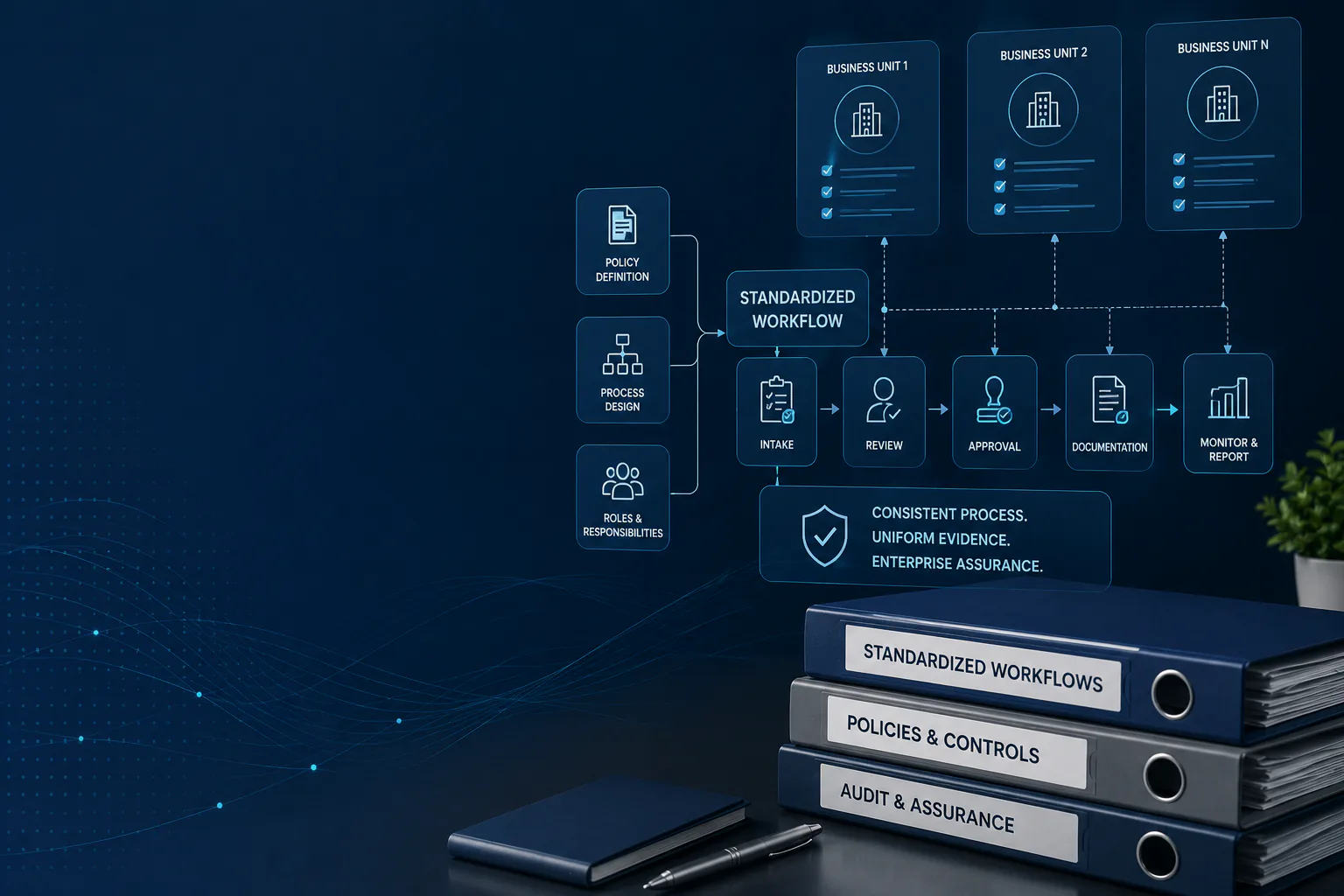
A workflow automation solution built for regulated enterprises addresses three things simultaneously.
Automated execution with a documented audit trail.
When a workflow runs on automation, every step it takes is logged. Every action, every routing decision, every approval and exception is recorded as it happens, not reconstructed afterward. For regulated enterprises, that logging is not a reporting feature. It is the compliance record. The audit trail that regulators and internal reviewers require is produced as a natural output of the workflow itself, without additional staff effort and without the variation that manual documentation introduces.
Role-based access controls built into the workflow architecture.
Not every team member who participates in a workflow needs visibility into every record that workflow touches. A properly structured workflow automation solution defines access at the role level, so each participant sees and acts on precisely what their function requires. That structure reduces internal data exposure, simplifies evidence gathering during audits, and creates a clear record of who had access to what, and when. For operations leadership, that documentation is not administrative overhead. It is what makes the operation defensible when reviewed from the outside.
Adaptive workflows that respond to regulatory change without full redesign.
When compliance requirements shift, a well-structured workflow automation solution does not require rebuilding from scratch. The underlying logic can be updated to reflect the new standard, tested against the existing process, and deployed without disrupting the full workflow. That adaptability is the difference between an organization that responds to regulatory change in days and one that spends weeks in operational adjustment while the queue continues to grow.
When these capabilities are built into the workflow from the design stage rather than added after implementation, automation becomes more than a throughput tool. It becomes a compliance asset, one that produces the documentation, the access records, and the audit evidence that regulated enterprises are required to maintain, as a natural output of daily operations rather than as a separate and costly exercise.
The Results: What the Research Shows
Automation can change a substantial share of operational work.
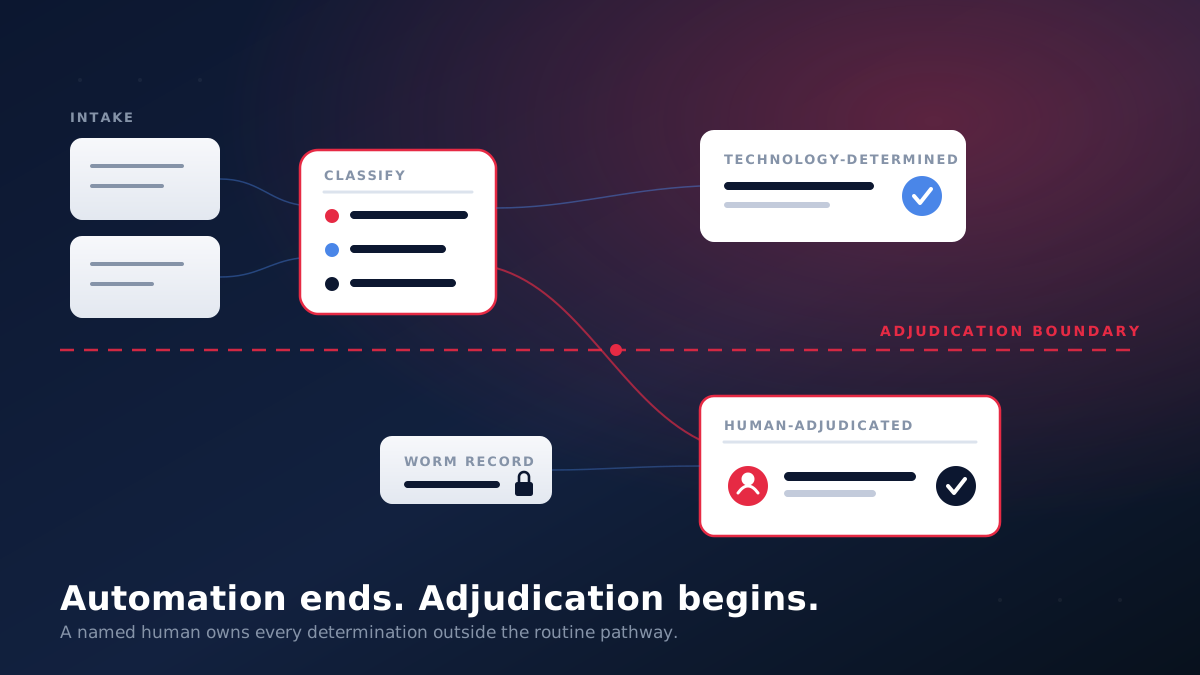
McKinsey estimated that 45 percent of paid work activities could be automated with demonstrated technologies. The useful lesson is not that every workflow should be automated, but that organizations should identify repeatable activities, preserve human accountability, and measure the result.
Source: McKinsey, “Four fundamentals of workplace automation”
Compliance investment should be compared with the full cost of non-compliance.
The Ponemon Institute’s published benchmark examines direct and indirect costs associated with compliance and non-compliance. Its findings are historical and should be used as a planning reference, not as a prediction of any organization’s savings.
Source: Ponemon Institute, “The True Cost of Compliance with Data Protection Regulations”
Automation programs need defined outcomes and measurement.
Gartner reported that hyperautomation remains common among large enterprises while fewer than 20 percent of organizations had mastered measurement of those initiatives. That gap reinforces the need to define operational, compliance, and service outcomes before expanding automation.
Source: Gartner, automation and hyperautomation research
Together, these sources support a measured approach: select work that is suitable for automation, retain accountable review, and evaluate whether the resulting workflow improves timeliness, evidence quality, and operational resilience.
Key Takeaways
Backlog is a compliance signal, not just an operational one. In a regulated environment, work that accumulates is work that may not meet its documentation, submission, or review obligations on time. Addressing backlog through workflow automation is not a productivity initiative. It is a risk management decision.
The audit trail should write itself. Manual documentation produces variation. Automated workflows produce a consistent, retrievable record of every action taken, every approval granted, and every exception handled. That record is what regulators ask for. It should not require a separate effort to produce.
Access controls are part of the workflow, not a separate IT consideration. Who sees what, and when, is a compliance question. A workflow automation solution that builds role-based access into its architecture answers that question by design, not by policy memo.
Regulatory change should not require workflow reconstruction. Organizations that manage compliance requirements through manual processes absorb the full cost of every regulatory update. Organizations with automated workflows absorb a fraction of that cost and respond faster.
The total cost of the backlog is almost always underestimated. Staff hours consumed by manual processing, error correction, audit preparation, and regulatory remediation represent a cost that rarely appears in full in standard operational reporting. When that cost is made visible, the investment case for workflow automation rarely requires additional justification.
GovSoft: Supporting Organizations That Operate in Regulated Environment
GovSoft works with regulated enterprises to design workflow automation solutions tailored to their compliance obligations, approval structures, and audit requirements.
If your enterprise is carrying a backlog that your current workflows were not built to resolve, GovSoft is a conversation worth having.
Learn more at govsoft.com