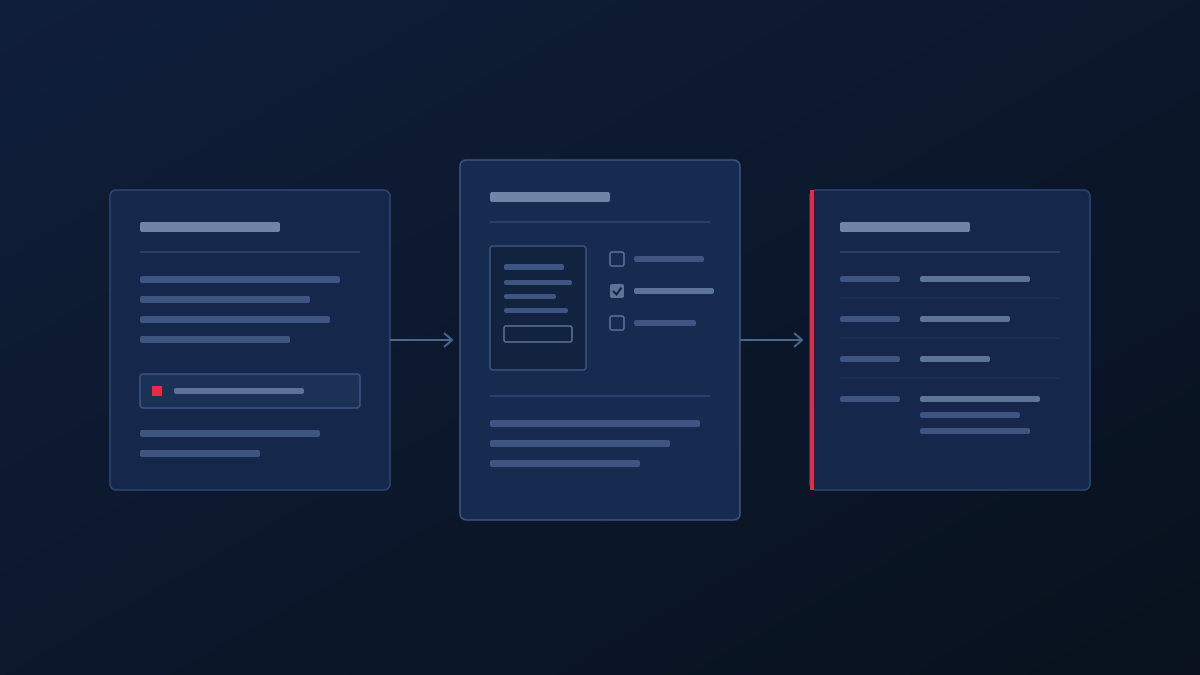
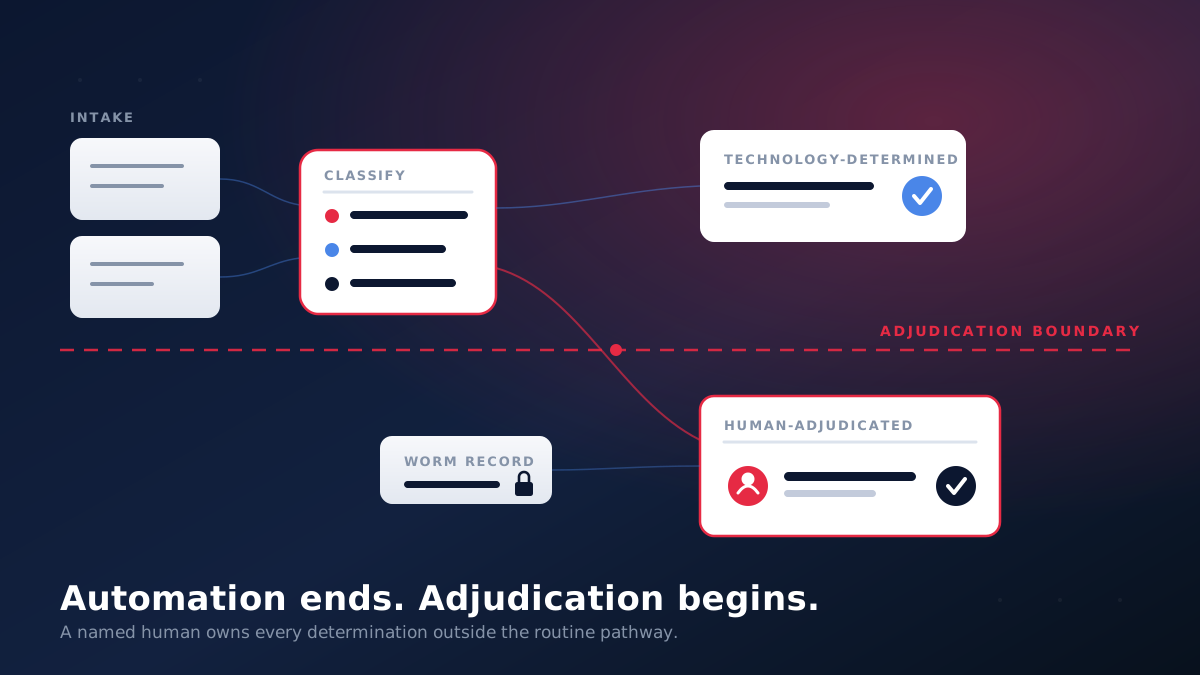
An AI system recommends requesting additional documents from an applicant. The employee assigned to the case reviews the recommendation, checks the record, and decides whether to proceed.
If the applicant questions that decision later, the organization needs to establish what the AI recommended, whether someone reviewed it, who made the final decision, and what information supported it.
Organizations use AI to review applications, analyze records, flag unusual transactions, and assist employees with decisions. These tools can process information quickly, but the people responsible for their results still need reliable records.
AI compliance management connects existing governance requirements to the people, decisions, and evidence involved in using AI.
What Federal AI Requirements Already Cover
The Office of Management and Budget (OMB) issued Memorandum M-25-21, Accelerating Federal Use of AI through Innovation, Governance, and Public Trust, on April 3, 2025.
The memorandum establishes governance requirements for covered federal organizations using AI. These include maintaining an AI use-case inventory, assigning appropriate leadership responsibilities, and applying additional safeguards to high-impact uses.
For AI classified as high-impact, the memorandum identifies minimum risk-management practices, including:
- Testing and assessing systems before deployment.
- Monitoring performance and risks after deployment.
- Providing appropriate human oversight and intervention.
- Establishing processes for appeals and remedies.
- Allowing affected people to provide feedback.
A high-impact use generally involves AI outputs serving as a principal basis for decisions or actions with significant effects on people’s rights or safety, as defined more precisely in the memorandum.
The deadline for implementing the minimum practices was 365 days after publication, falling on April 3, 2026, subject to the memorandum’s scope and provisions.
These requirements give organizations a basis for deciding how AI should be governed. The next operational task is connecting that governance to specific systems and decisions.
What GAO Adds to the AI Accountability Discussion
The U.S. Government Accountability Office (GAO) provides a separate framework for examining whether AI systems are being managed responsibly.
Its 2021 AI Accountability Framework (GAO-21-519SP) organizes accountability around four principles: governance, data, performance, and monitoring.
Governance addresses responsibilities and oversight. Data practices examine whether information used by AI is reliable and appropriate. Performance concerns whether systems achieve their intended objectives. Monitoring considers whether systems remain suitable over time.
GAO revisited these practices in congressional testimony published on May 16, 2023, as GAO-23-106811.
The framework helps managers and auditors examine an AI system throughout its development and operation. It is an accountability resource rather than a separate law imposing the same requirements on every organization.
For example, an organization using AI to assist with reviewing applications should be able to explain the system’s purpose, the data it uses, how its performance was assessed, and what monitoring takes place after deployment.
Managers also need to understand what happens when employees use the system in individual cases.
That connection between system-level oversight and everyday decisions is where a well-maintained review record becomes useful.
What Changed in Bank Model Risk Guidance in 2026
Banks have long used model-risk management practices to assess quantitative models used in areas such as credit, forecasting, and financial risk.
In April 2011, the Federal Reserve issued supervisory guidance SR 11-7, alongside related OCC guidance, describing sound practices for model development, validation, governance, and oversight.
On April 17, 2026, the Federal Reserve, Office of the Comptroller of the Currency (OCC), and Federal Deposit Insurance Corporation (FDIC) issued revised model-risk management guidance.
The Federal Reserve published it as SR 26-2. The revision replaces the earlier guidance and takes a more risk-based approach, recognizing that model-risk practices should reflect an institution’s size, complexity, and exposure.
The Federal Reserve identifies banking organizations with more than $30 billion in total assets as the institutions for which this guidance is expected to be most relevant.
An important distinction is that SR 26-2 is supervisory guidance, not a binding regulation. It describes sound risk-management practices rather than establishing independently enforceable requirements. However, regulators may still take supervisory action when inadequate model risk management results in violations of law or unsafe or unsound practices.
The guidance also explicitly excludes generative and agentic AI models from its scope.
This exclusion reflects the different characteristics of those technologies. Banks remain responsible for deciding how such tools should be governed under their broader risk-management responsibilities and other applicable requirements.
The guidance also discusses identifying responsibilities throughout a model’s lifecycle and ensuring effective challenge by people with sufficient independence. The quality of that challenge matters more than imposing one organizational structure for validation.
These principles provide useful experience for institutions designing governance around newer AI technologies, even when the guidance does not directly cover those tools.
Give Each AI System a Responsible Owner
An AI inventory establishes which systems an organization uses and what purposes they serve.
Ownership makes that inventory more useful.
Each significant AI system should have a person responsible for coordinating its governance. That person’s duties should be documented and matched to the system’s purpose and level of risk.
For example, someone responsible for an AI-assisted application review system should know which department operates it, what kinds of recommendations it produces, and who can approve changes to its use.
The owner should also coordinate periodic reviews and make sure important findings reach the people authorized to address them.
Technical specialists may evaluate performance, legal teams may interpret requirements, and operational managers may approve particular uses. These responsibilities can remain separate while one named person coordinates the overall governance process.
OMB M-25-21 and the banking guidance already recognize the importance of assigned responsibilities. GovSoft’s approach builds on those principles by connecting the ownership record to the reviews and decisions associated with each system.
This allows managers to identify who is responsible when a question arises after deployment.
Keep a Record of AI Recommendations and Human Decisions
An AI-assisted application review provides a practical example of how accountability works.
The AI system examines information submitted by an applicant and recommends that additional documentation be requested. An authorized employee reviews the recommendation, checks the relevant records, and decides whether the request is appropriate.
The organization should retain enough information to explain that decision later.
A useful record may include the case identifier, the AI system and version involved, its recommendation, the reviewing employee, the action taken, and the time of the decision. Supporting reasons and evidence should be available where required, with appropriate controls for sensitive information.
If the employee rejects or changes the AI recommendation, the record should preserve that action as well.
GovSoft recommends recording the review as an authenticated action by the employee, rather than relying on a status assigned by the AI system itself.
This distinction is important when a person later requests an explanation, raises a complaint, or appeals an outcome.
For federal high-impact AI, such records can help demonstrate how human oversight and intervention operated in a particular case. For banks and other regulated organizations, they may support internal investigations, performance analysis, and risk reviews.
The appropriate level of detail depends on the system, the decisions being made, and applicable privacy and recordkeeping obligations.
GovSoft recommends connecting these records to existing AI inventories and approval processes so important decisions can be traced without manually reconstructing their history.
Related reading: Human in the Loop AI: The Role of Human Review in High-Impact Decisions and Someone Has to Own the AI Decision.
Apply Oversight According to the Risk
Not every AI application presents the same level of risk.
A tool summarizing internal meeting notes may require different controls from one influencing an individual’s eligibility for a public service.
OMB M-25-21 applies its minimum high-impact practices to covered high-impact AI uses. Other covered systems still have applicable governance and reporting obligations but are not automatically subject to every high-impact safeguard.
An internal AI assistant may need an identified owner and routine monitoring. A system involved in consequential recommendations may warrant documented human review, stronger access controls, and records supporting later investigation.
The appropriate controls depend on what the system does, the information it handles, who may be affected, and the consequences of an incorrect result.
Where AI Can Help With Its Own Governance
AI tools may assist with some of the work involved in monitoring other AI systems.
They can help organize review records, identify missing documentation, compare system activity against established conditions, and flag unusual results for further attention.
For example, an automated process could identify a decision that falls outside an expected pattern and direct it to the employee responsible for reviewing that type of case.
AI may also summarize earlier incidents or review findings to help managers understand what has changed.
These capabilities require careful testing and reliable source information. Automated summaries can be incomplete, and unusual activity does not always indicate a problem.
The governance process should make clear which actions can be automated and which require a qualified person’s approval.
The record of a human decision should come from that person’s authenticated action, with the relevant supporting information retained under applicable policies.
How GovSoft Approaches AI Compliance
GovSoft focuses on connecting AI governance responsibilities to the work performed around AI systems.
The approach starts with an organization’s existing AI inventory and governance arrangements. From there, it develops workflows for assigning ownership, routing reviews, documenting significant decisions, and maintaining supporting evidence.
Existing AI platforms, model inventories, and validation processes can remain in place. The proposed workflow connects the relevant activities so that managers can see what was reviewed and who was responsible.
For an AI-assisted application review, this means connecting the system’s recommendation to the employee’s recorded decision and any later action or appeal.
For an AI tool used internally, the appropriate process may be simpler, focusing on ownership, approved uses, changes, and periodic checks.
The design should reflect the organization’s actual responsibilities and risk rather than imposing the same approval process on every AI application.
GovSoft’s role is to help make those responsibilities and decisions easier to follow and review.
A useful starting point is to select one AI system involved in an important decision and check whether the organization can answer three questions:
Who was accountable? What was checked? Can it be proven afterward?
If the answers require searching through separate records and asking several employees to reconstruct what happened, the review process may benefit from clearer ownership and evidence tracking.
To discuss your organization’s AI governance needs, say hi at hello@govsoft.com or visit govsoft.com.
Key Takeaways
- Federal AI governance requirements under OMB M-25-21 include inventories and additional safeguards for high-impact uses, including human oversight and processes for appeals.
- GAO’s AI Accountability Framework helps organizations evaluate governance, data, performance, and monitoring throughout an AI system’s lifecycle.
- SR 26-2 is non-binding supervisory guidance. It excludes generative and agentic AI, leaving banks to determine appropriate controls through their broader risk-management arrangements.
- Named ownership and reliable review records help connect system-level governance to important AI-assisted decisions.
- Oversight should reflect the consequences of each AI use, with authorized people responsible for decisions requiring judgment.
Frequently Asked Questions
What AI compliance means
AI compliance involves meeting applicable legal, regulatory, and organizational requirements for developing, deploying, and using artificial intelligence. It includes governance, risk assessment, monitoring, accountability, and evidence of required actions.
Whether OMB M-25-21 requires human oversight
Yes. The memorandum includes human oversight and intervention among its minimum risk-management practices for covered high-impact AI uses, subject to the memorandum’s scope and provisions.
Whether SR 26-2 applies to generative AI
No. The April 2026 guidance explicitly excludes generative and agentic AI models. Banks must determine suitable governance for those technologies under other applicable requirements and their broader risk-management practices.
What evidence organizations should keep for AI-assisted decisions
Depending on the use, records may include the system’s recommendation, the final decision, reviewer identity, timestamps, supporting information, and any documented intervention or appeal. Privacy, security, and retention requirements determine how that information should be handled.